
SEM Agency Budgets: When AI Mode Pays Less
As of November 2026, a paid search account that measures everything on last click will read AI Mode traffic as a cost problem. Google states that AI Mode queries are on average three times longer than traditional searches, that many of them are upper-funnel queries, and that Google monetises them below what it earns on traditional search. That is the frame an sem agency has to work inside: the new inventory is real and it is being scaled to Singapore, but the discount for early-stage clicks does not exist. The practical answer is to fund discovery as a bounded test line with its own target, and keep the bottom-funnel campaigns judged as they are.
Key takeaways:
- Ads in AI Mode are now running in Singapore, and Google plans further locales later, so the placement is no longer hypothetical for a Singapore advertiser.
- The scarce number is not reach. Google has published useful intent and behaviour figures, and nothing on how AI Mode ads convert per unit of spend.
- Long queries convert badly on last click by design, not by accident; a reporting split by query length is what separates the two cases.
- A test line with a fixed share of budget, a named success metric and its own attribution review keeps the rest of the account honest.
What Google Actually Said
Two events on the same day set the frame. In October 2026, Google's data science lead told the Ads Decoded audience that shoppers now bring longer, more exploratory questions to Google, and the same afternoon Alphabet's chief business officer told investors that the strong growth in AI Mode queries worked against search revenue because those queries monetise lower. Search Engine Journal covered both statements and turned them into account advice.
The investor-side wording matters more for a budget owner than the podcast. AI Mode queries are described by Google as largely upper-funnel, a source of new commercial intent rather than a replacement for the queries the account already buys, and the majority of them are described as incremental. For anyone writing a 2027 PPC budget in Singapore, that is a statement about inventory expansion, not about your cost per acquisition getting better.
Why Up-Funnel Clicks Look Cheap Or Expensive Depending On The Report
Two filters decide whether new inventory looks like value or waste, and neither is set by the media buyer.
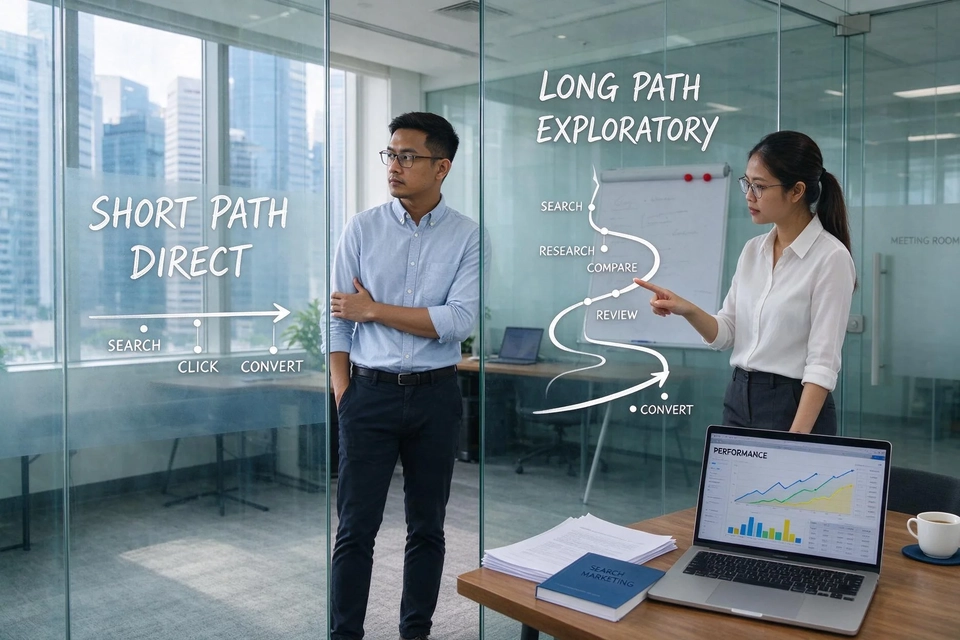
The first is the platform's attribution window. Google Ads attributes a conversion to a click within a fixed window, and a long decision cycle that closes after that window is discarded by the bidding model. An enquiry that starts with a category question in AI Mode, runs through a sales conversation and closes weeks later is the kind of journey outside the model's view. The click is paid for; the revenue it produced never trains the algorithm.
The second is query length. The buyer who types a twenty-word question about a specific situation is not the buyer who types a category term, and Google's own query data points the same way: AI Mode queries are three times longer than traditional searches, and query volume in the exploratory directions is where growth sits.
Put the two together and a predictable distortion appears. A campaign that serves exploratory queries shows many clicks, few or no tracked conversions, and a cost per conversion that looks unacceptable next to a branded campaign. An sem agency reading only that number will pause the campaign and go back to the terms it has always bought.
What A SEM Campaign Becomes When Intent Moves Up The Funnel
Before changing a budget, build the evidence. Export the search terms report and group terms by length. Compare three things inside each group: conversion rate, cost per acquisition, and how often the group appears as an early touch in the conversion paths report. This is the same diagnostic logic as recording the funnel step where the money leaks, and it produces one of three outcomes:
| Search-term group | What it looks like on last click | What to check next | Budget action |
|---|---|---|---|
| One to three words | normal or good conversion rate, high share of spend | nothing, this is the harvest line | protect it |
| Four to seven words | mixed, often poor | early touches in the paths report | keep, watch monthly |
| Eight words or more | poor conversion rate, rising spend share | whether the group shows up in any conversion path | move to the test line |
A group that converts poorly on last click but appears as an early touch in conversion paths is upper-funnel evidence finance can act on. A group that appears nowhere is discovery spend without a justification, and it should be tightened with negatives and brand controls rather than funded on faith.
What Changes In The Account This Month
Eligibility comes first. Ads inside AI Mode and AI Overviews are matched to both the query and the content of the AI answer, and only broad match keywords or keywordless targeting can serve inside the answer; exact and phrase match keep their position above or below it. A non-brand campaign built entirely on exact match is, in effect, sitting out the placement Google is scaling, including in Singapore.
Second, long queries need somewhere specific to land. A person who asked a long, situational question does not convert on a generic category page, and when final URL expansion chooses the landing page, thin pages get picked for nuanced queries. Audit the highest-spend landing pages against the comparisons, sizing, pricing and use cases the long query is asking about.
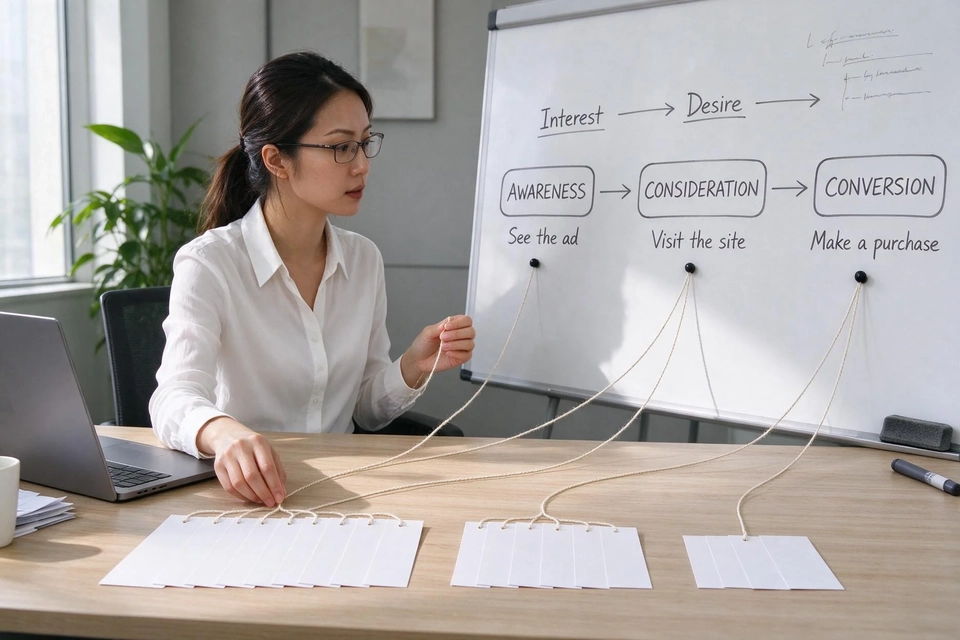
Third, the success metric has to be stated before the money moves. For a discovery test line in Singapore, the honest metrics are early-touch frequency and the share of eventual conversions that touch the line at all, not last-click CPA.
Fourth, the creative and asset supply has to keep pace. In its latest reported quarter, Gemini models helped advertisers generate over 1.5 billion campaign assets, so the constraint on testing is no longer asset production but the test design that tells you which asset earned the conversion.
Splitting The Budget Without Raising It
The mechanism that fits this problem is simple: divide the budget into test lines, test several ideas at once, and change their proportions rather than the total. A monthly PPC budget in Singapore can be split three ways:
- Harvest line: branded and high-intent non-brand terms on exact and phrase match, measured on last-click CPA and protected.
- Expansion line: broad match and keywordless campaigns deliberately opened to AI Mode and AI Overviews, measured on early touch and assisted conversion share.
- Test line: a fixed small share for new inventory, such as long-form queries on a campaign that can capture them, with a decision date and a stated threshold.
Google's own reporting tools now support part of this. Advertisers can test different budgets and ROI targets across several Search campaigns in a single AI Max A/B test, which is a cleaner way to compare two allocation choices than comparing two calendar months. For a Singapore advertiser without that setup, the same comparison works by running the expansion line against a holdout period of the same length.
The method is the one an sem agency singapore budget belongs to: search ads capture the demand that already exists, and expansion formats cover the demand that does not yet look like a keyword. The difference now is that the expansion side needs its own ruler, because the platform's ruler will always read it as expensive.
Where The Comparison Stage Lands
This is the question the generic SEM guides leave open, and it has a concrete answer in the account structure. A traditional SEM campaign is a keyword list, a bid strategy and a landing page aimed at a person who already knows what they want to buy; that is the setup most sem agency retainers are built around. When a share of search intent moves up-funnel, the campaign has to carry two jobs at once, and the keyword list stops being the organising idea.
The organising idea becomes the funnel stage the query sits in. Harvest campaigns keep exact match, tight negatives and a short landing page that answers a purchase question. Discovery campaigns run broad and keywordless targeting, carry a wider asset set, and send traffic to pages that answer the comparison and setup questions the AI answer just raised. One account, two audiences, two rulers.
The telling detail is comparison behaviour. Google's own research on what shoppers do when they are near a decision describes people who decline to read a summary and go looking for reviews, podcasts and videos from others in their situation. That is a landing-page and asset problem, not a bidding problem, and it is the one most accounts have not solved because their keyword lists never surfaced those queries.
That expansion is visible in Google's own research numbers: AI Mode has surpassed a billion monthly active users globally, and AI Mode queries have more than doubled every quarter since launch. Behaviour is moving faster than most account structures have.

How To Read The Signals Without Overclaiming
The published signals are directional, and a budget owner should hold them at that level. AI Mode queries count more than doubled every quarter since launch. In the U.S., more than 1 in 6 searches now use voice or images, and image searches there are growing over 40% month over month. In the past 6 months, AI Mode queries about planning grew 80% faster than AI Mode queries overall. Brainstorming queries have grown 30% faster than queries overall since launch.
The multimodal share is consistent across sources and markets: one in five AI Mode searches globally use voice, images or documents. None of these figures says a Singapore account will see the same mix, and none of them says a conversion will follow. They say where query volume is heading, which is a planning input, not a performance result.
The performance side is thinner than it looks. The only published AI Mode ad figure is that click-through rates are already similar between sponsored and organic product list items within AI Mode. That compares ads to organic listings rather than to your existing Shopping campaigns, it comes from Google's own measurement, and it says nothing about what happens after the click. Treat it as a reason to test, not as a reason to move budget. For the organic half of the same shift, Topkee's own reading of how AI Overviews and visual search change SEM covers what happens when the query no longer arrives as a typed keyword, and the note on AI visibility versus search rankings explains why an impression inside an AI answer is a different measurement problem from a rank position.
The Topkee Read: Harvest Below, Expand Above
At Topkee, paid search is treated as a revenue path rather than a click purchase. The method runs from impression through click, landing page, enquiry, proposal and signed deal, with budget moved by ROAS from channels and ad groups that underperform to the ones that convert. That full-funnel span is the vertical optimisation coverage, not a claim that spend should drift upward, and the distinction matters when the platform starts selling discovery inventory.
The expansion side is where Topkee Media's practice already has a defined answer. Performance Max runs across Search, YouTube, Gmail, Display and Shopping from one campaign, which is the practical way to buy a wider set of placements than a keyword list can reach. Search ads keep capturing the demand that is already explicit; the cross-channel format covers the audience that is still deciding, and the budget between them is set by measured return.
Two of the company's own systems support the measurement side of the decision. Its campaign intelligence reports combine four data sources into one funnel from impression to signed deal and score each layer against signed-deal value divided by ad spend, which is what makes an assisted conversion countable rather than arguable. Its funnel tuning agent was built to split a budget into three test lines and change the proportions rather than the total, which is the same mechanic described above.
The same reading applies to the order of work. A funnel trace that loses most of its traffic between the click and the first page interaction is a relevance and landing-page problem, and extra upper-funnel reach cannot repair it. Fixing that leak before adding discovery inventory is the sequence the report is built to expose.
A Decision Framework For Next Quarter
The choice between chasing cheap bottom-funnel conversions and buying exploratory reach is not a blog-level philosophical one; it is a portfolio decision with a review date. Three conditions decide it:
- Do the harvest campaigns have a clean funnel trace from click to signed deal, with the biggest leak identified and fixed? A sem agency singapore team should be able to show that trace per campaign, not per account.
- Does the expansion campaign have a landing page that answers the comparison questions a long query raises?
- Is there a named metric for the test line, and a date on which it is judged?
Two yes answers and an open test line is a defensible budget. Buying discovery inventory while the click-to-interaction rate is still the biggest leak is spending more money on a funnel that loses most of its traffic anyway.
FAQ
Is paid search really moving up the funnel?
Google's own description is that many AI Mode queries are upper-funnel queries that let it capture new commercial intent, and that the majority are incremental. That is a statement about where new query volume sits, not a claim that bottom-funnel buying stops working.
Why would a Singapore advertiser see AI Mode traffic at all?
Ads in AI Mode are being scaled in ten markets that include Singapore, and Google plans further locales later. A non-brand campaign on broad match or keywordless targeting is the realistic way to reach that inventory.
Is AI Mode cheaper or more expensive than traditional search?
For Google, it is described as monetising below traditional search. For the advertiser, the cost per click comes from the same auction, so the cheaper placement should not be assumed; what changes is the phase of the journey the click belongs to.
How much budget should go to the test line?
The right answer, and the one an sem agency should write into the proposal, is a share that can be lost without threatening the quarter, with the total unchanged. The mechanic is to thin the harvest line slightly, add an expansion line and keep the total fixed, then let the review date decide whether the proportion moves.
What should the test line be measured on?
Early-touch frequency and the share of eventual conversions in which the line appears at all. Last-click CPA will always punish it, and a blended cost per acquisition will hide the difference between the two lines.
Sources
- "Paid Search Is Moving Up The Funnel – Google Admits AI Mode Pays Less", Search Engine Journal, 2026-11-10. https://www.searchenginejournal.com/paid-search-is-moving-up-the-funnel-google-admits-ai-mode-pays-less/595875/
- "Ads in AI Mode expand to new markets", Google, fetched 2026-11-10. https://blog.google/products/ads-commerce/ads-in-ai-mode-global/
- Shivani Mohan, "How AI Mode is changing and expanding the way people search", Google / Think with Google, 2026-05. https://business.google.com/us/think/search-and-video/ai-mode-us-insights/
- "Alphabet Q3 2026 Earnings Call Transcript", Alphabet Inc., 2026-10-28. https://s206.q4cdn.com/479360582/files/doc_events/2026/Oct/28/2026_Q3_Earnings_Transcript.pdf