
TPU 8tx and 8i Max: What Agentic Compute Means for Your Business
As of November 2026, the cheaper, more private inference that Google announced this month does not remove the hard part of an agentic project. It removes the excuse. If your agent cannot show where a figure came from, who approved an action or what happens when a step fails, faster silicon only makes the gap wider.
That is the short answer to the question most managers are asking after hearing that Google shipped new chips "built for the agentic era". The hardware story is real and worth understanding. The decision you face is whether to move an agent pilot into production this quarter, and that decision is governed by process, not by a benchmark.
This article looks at what changed on the compute side, then at the layer most businesses actually own: the workflow rules, the approvals, the application your staff use to check the agent's work, and the system connections behind it. If you are planning ai automation for business and wondering whether the new hardware changes your plan, read the governance question first and the chip details second.
Key takeaways
- Google describes four new eighth-generation TPU systems in a single year: 8t for training, 8i for reasoning, plus the new 8tx and 8i Max.
- TPU 8tx is aimed at hardware-level confidential inference and low latency for multi-step agents; TPU 8i Max is aimed at massive context windows and compute density per rack.
- TPU 8i offers 80% better inference price performance than the previous generation, which lowers the running cost of long agent conversations.
- The open software stack matters as much as the chip: TorchTPU and the XLA Serving Engine shorten the path from a prototype to a served model.
- The bottleneck after all of this is where agents meet business systems: permissions, verification and human handover.
What did Google actually ship, and why now?
Amin Vahdat, SVP and Chief Technologist for AI and Infrastructure at Google, wrote in November that the company had expanded its eighth-generation TPU portfolio with TPU 8tx and TPU 8i Max, "marking four new TPU systems in a single year". That pace is unusual, and it is the reason the announcement reads as a product story rather than a single chip launch.
Two numbers in that post explain the audience. TPUs now serve nearly 100 customers, including frontier labs, trading firms, retailers and universities. And compared with the previous generation, TPU 8t and 8i offer up to 2.7 times better training performance and 80% better inference price performance respectively.
The new systems sit on top of that baseline and each answers a different production problem. That is the first thing to understand about the announcement: these are systems, not chips. Google's own framing is that a chip is a multi-year silicon project, while a system is how compute, networking, memory and storage are assembled around it. A business reading the news is being sold on configurations, not on transistors.
What does TPU 8tx mean for confidential agent workloads?
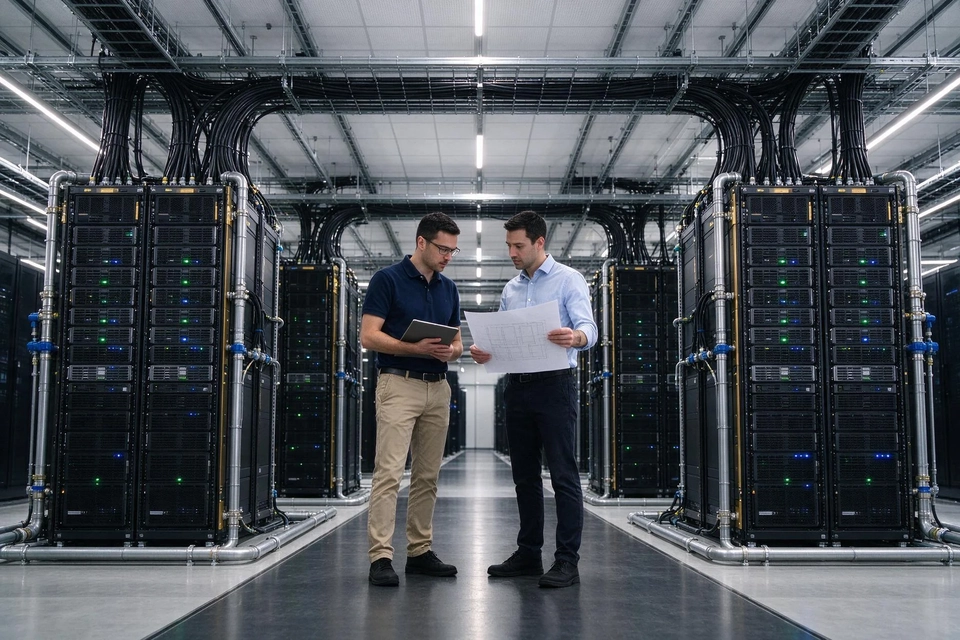
TPU 8tx is the most directly relevant of the two new systems for a regulated enterprise. Google positions it for secure and confidential inference, and also for small-scale training, aimed at enterprises and governments running frontier or proprietary models and autonomous agents next to their most sensitive data.
The mechanism is the part worth remembering. Normally, data is encrypted at rest and in transit but has to be opened up in memory while a processor works on it. TPU 8tx, built on the same silicon as TPU 8t and paired with 5th Generation AMD EPYC CPU hosts, builds that protection into the hardware layer, keeping sensitive data and model weights isolated even in active use. It also adopts the low-latency Boardfly network, giving up to 2x lower latency than TPU 8t with a near-zero performance penalty.
For a bank, insurer or healthcare operator, that combination answers a familiar objection. A team can fine-tune a model on private data, distil a large model into a smaller one, and train an agent through reinforcement learning without moving sensitive data between separate clusters.
What does TPU 8i Max mean for long-context agents?
TPU 8i Max addresses a different queue: the memory wall. When dozens of agents work across an entire codebase or hours of video at once, memory bandwidth becomes the limit rather than raw compute.
Google's answer was to place two low-latency TPU 8i chips on a single package. The result scales compute and memory together, delivering double the compute, double the SRAM and double the HBM bandwidth of TPU 8i. Because it fits twice the silicon within the existing rack footprint, data centres can deploy more computing power per square foot and per watt.
The practical translation for a marketing or operations team is less glamorous than the spec sheet. Long-context work, such as reading a year of enquiry emails or reviewing a large product catalogue, stops stalling halfway. The earlier TPU 8i design already cut inter-chip communication delays by up to half; the Max variant pushes the capacity that makes those long runs possible.

Does cheaper inference change your automation business case?
It changes the running-cost line, and that line has been the sticking point for many pilots. An agent that pauses for seconds or hours waiting on a database lookup, an external tool or human feedback burns infrastructure time. Google's Agent Compute Engine suspends and resumes idle sessions automatically, and Google positions that as a cut to operational infrastructure costs.
The model-state layer, open-sourced as TPU Sync, addresses the same waste from another direction. It tiers large KV caches off the chip, streams context across separate prefill and decode nodes, and synchronises reinforcement-learning weights, cutting KV transfer latency and Time to First Token by more than 90%.
For teams weighing ai automation for business projects, two more scheduling items complete the picture. Cloud Pathways is now generally available on Google Kubernetes Engine, letting one controller orchestrate large TPU systems across slices. GKE dynamic slicing, also generally available, assembles TPU cubes into larger topologies or partitions them on the fly, slashing job startup times by up to 5x and accelerating fault recovery by up to 4.5x.
None of this makes an agent correct. It makes an agent cheaper to keep running while it waits, which is the condition under which a long-lived automation earns its place.
How do open source tools shorten the path to production?
Hardware only reaches a business once software opens the route, and Google moved on the software side too. TorchTPU, announced as open source last month, lets PyTorch code and Hugging Face models run natively on TPUs. Lohmeyer and Jia report in that post that TorchTitan training paths demonstrated up to 52% Model Flops Utilization on the 8B version of Qwen, with near-linear scaling across its validated Ironwood TPU fleet, and that TorchTitan has been validated running with up to 8000 Ironwood TPUs.
Serving got its own piece, when Google open-sourced the XLA Serving Engine under the Apache 2.0 licence. Oleg Shaldybin and Monica Song describe it as a "train in Python, serve in C++" workflow for the OpenXLA ecosystem, aimed at cases where a production environment cannot run a Python interpreter.
Read together, these announcements describe a stack that is easier to adopt than it was a year ago. That is also the honest boundary of the story: easier adoption does not mean the business model, the approval chain or the data contract is settled. Those are yours.
The layer you actually own: workflow, permissions and handover
Here is where the vendor narrative stops and your project begins. A faster accelerator does not decide which tasks an agent may run unsupervised, which figures a person must check before a report leaves the building, or what the agent should do when an interface returns an error.
Those decisions look like small details until they are not. A monthly marketing report that connects ad-platform and CRM data needs a rule for how metrics are calculated, a person to check figures, sources, brand and permissions, and a place where the finished report is saved. A customer enquiry agent needs a route for missing information and a handover when the answer is uncertain. Without them, cheaper inference buys you more of the wrong thing.
This is the question most teams leave open when they read the announcement: what an enterprise should actually do with cheaper, more secure agentic compute. Our answer, for ai automation for business programmes we see, is to spend the freed budget on the deployment and governance layer, not on another model comparison. Name the metrics you already track, such as collation and review time, figure consistency, or the reasons reports are reworked, and use them as the acceptance test for the agent. Two web application development pages that help here are what to automate in a creative studio pipeline and AI automation for business data in email.
A practical sequence holds up across most cases:
- Pick one recurring task with a visible output, and write down the three failures that would embarrass the business if the agent caused them.
- Decide the human confirmation points for that task before any interface work starts.
- Connect only the systems that task needs, and check that each one has an authorised interface.
- Agree the samples, scoring rules and pass threshold for the output before the build, not after.
- Run a pilot with real records, then review the rework reasons before expanding scope.

Where does Topkee fit: the application and integration layer
Topkee's work sits on the side of the problem that a new TPU does not touch. Its Topkee AI Agent platform, for example, starts from a natural-language goal, matches skills and tools to the task and connects authorised business services. The custom AI Agent development service behind its ai automation for business offer turns business rules into executable agents by drawing on enterprise knowledge, task steps and the tools available, with explicit triggers, inputs and outputs, plus human confirmation points, covering knowledge retrieval, orchestration, tool calls, permissions and failure handling.
The delivery stance written into that service is a check-list worth borrowing whether you work with Topkee or not: sources traceable, execution permissioned, outputs acceptable, handover possible. A project plans the task, the interface and the business resources together, and backend, API and integration work shared by an application and its agents is built once and billed once.
The cross-border setup matters for teams that think their constraint is headcount. Topkee provides Hong Kong enterprises with enterprise AI automation covering workflow automation, app and web application development, CRM and ERP integration, and ongoing maintenance, from process assessment through testing and go-live. The four design requirements it applies are specific: data has provenance, execution has permissions, outputs are verifiable, and delivery is transferable.
On the application side, that answer takes a concrete shape. If your staff need to see an agent's progress, edit an output, approve a step or take over an exception, you need a workbench, not a chat window. That is a web application development problem as much as a model problem: interface and experience design, a shared business backend, role permissions and mobile access. Topkee's business-collaboration package covers a smaller set of web pages including the admin pages, and its mobile package covers a larger set of mobile pages plus a few back-office pages on a shared iOS and Android codebase.
None of this is a promise of a result. The worked workflows are illustrations, and no conversion or revenue uplift ratio is offered. What the notes do give you is a shape for the project: four phases, moving from assessment and design into build and pilot, then acceptance and go-live, with continuous improvement after that and a defect warranty period on the agreed scope once you accept.
Does this mean you should build in-house or use a partner?
Which route suits you depends on what you already have. If your team holds the interfaces, the business rules and the domain knowledge, and can spare an engineer to own the orchestration and permissions, the opened-up tooling makes an in-house path more realistic than it was.
Conversely, this advice does not suit a business that has no agreed definition of the task, no owner for the data and no appetite for a pilot with measured results. In that case a new accelerator changes nothing, and buying development capacity will simply produce an unchanged process faster.
For the in-between case, a delivery partner is a reasonable way to keep the backend and integration work from being built twice. Topkee's integration practice prefers existing reusable interfaces and connectors, lists new adapters separately, and does not bill work already covered by an existing contract.
FAQ
Is TPU 8tx something my company can use directly?
TPU 8tx is Google's system for secure, confidential inference, aimed at regulated enterprises and governments. Whether you can use it directly depends on your cloud and data-centre arrangements with Google, not on the announcement itself; most businesses meet it through a provider's service rather than a purchase order.
Do cheaper TPU systems lower the cost of an AI automation project?
They lower the infrastructure line for inference and idle agent time, which is one part of running cost. Development, integration, process design and human review sit outside that line, so a business case built only on compute savings will understate the work.
What should I start automating first?
Choose one recurring task with a visible output, such as a monthly marketing report, enquiry follow-up or product content production, and name the three failures that would matter most. Starting with a task you can score against agreed samples gives a pilot a defensible result, and the project can then earn its full place in any ai automation for business roadmap.
How much handling does a confidential agent workflow need?
At minimum, data provenance, execution permissions and verifiable outputs, with a defined path when an agent cannot complete a step. Hardware-level protection helps with data in use; it does not replace the rule that says which records an agent may read and which actions it may take.
Should I wait for the next generation of chips?
There is no strong reason to wait if your bottleneck is process. The cost and latency improvements are real, but the failures that stop an agent pilot from reaching production are usually in permissions, verification and handover, and those improve on their own schedule.
Sources
- "Our newest TPUs: 8tx and 8i Max, built for the agentic era", Google Blog (The Keyword), 2026-11-09. https://blog.google/innovation-and-ai/infrastructure-and-cloud/global-network/tpu-8i-max-and-8tx/
- "TorchTPU is now open source: Run native PyTorch on TPUs", Google Cloud Blog, 2026-10-21. https://cloud.google.com/blog/topics/ai-infrastructure/torchtpu-is-now-open-source-run-native-pytorch-on-tpus
- "Supercharging XLA-based inference: Announcing the launch of XLA Serving Engine", Google Open Source Blog, 2026-11-05. https://opensource.googleblog.com/2026/11/supercharging-xla-inference-xla-serving-engine.html