
Google Ads AI summaries: what advertisers must supply before Google writes them
As of November 2026, a marketing lead at a Singapore clinic chain finds her ads sharing the screen with a paragraph Google wrote, not her. Search Engine Roundtable reported on 9 November 2026 that Google is testing AI-generated summaries inside and above the sponsored block on mobile: each individual ad has its own description for the business, and an additional description at the top of the sponsored results mentions the brand names that are listed with an additional link to their ads. If you are briefing a sem agency this quarter, the question is no longer who writes the sharpest headline. It is who hands Google the raw material the summary needs.
The change does not make copywriting irrelevant. It moves the value up a level, from the sentence to the asset set, and it makes the account's weakest statement the one a stranger reads first.
What Google is testing in the ad slot
The report describes a layout where generative text appears twice on one screen. Under every advertiser's ad sits a description of that business. Above the group sits a second description naming the brands listed beneath it, each with a link through to their ads. Brodie Clark, who spotted the test, described the sponsored results on mobile as increasingly generative, and said the summary at the top of the ads was new to him.
A loading animation runs while the summaries are generated. That detail matters more than it looks. The text is composed at request time, per impression, from material Google already holds: headlines, descriptions, extensions, business data, the landing page. It is not a template you write once.
Google has run AI descriptions in sponsored ads before, and in sponsored shopping units. What this observation adds is the layer across the whole sponsored group, written about several advertisers at once. No advertiser writes that paragraph. Every advertiser's words go into it.
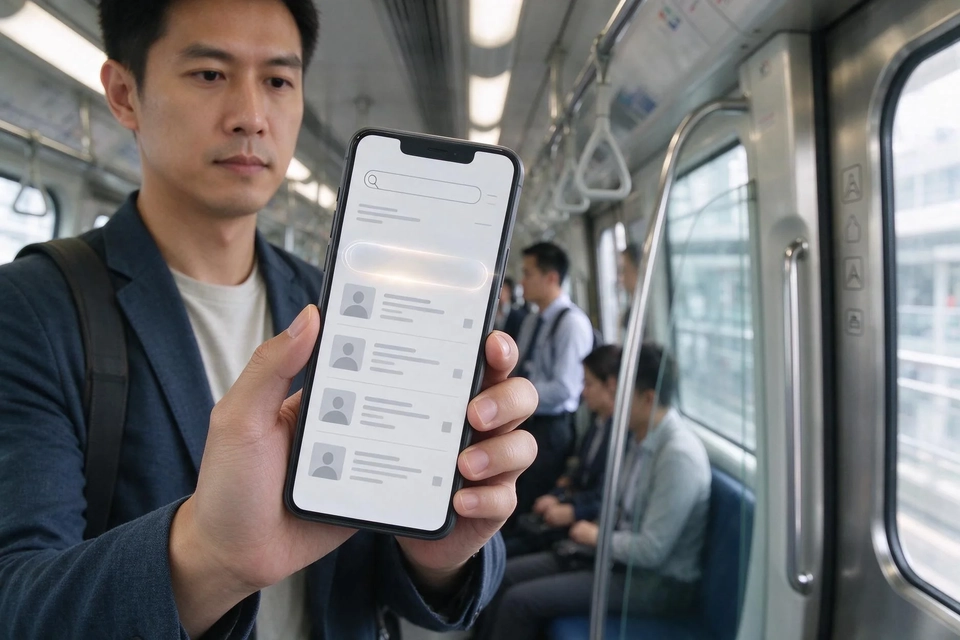
Why the ad group is now the unit that matters
When a summary spans advertisers, the reader compares offers in one pass, under a paragraph Google supplies. Your ad still appears, but it competes for a glance rather than for the click on its own merits.
That changes what a well-built account looks like, and the change is easiest to see in three places.
The first is the distinctness of the offer. If your headline says "trusted dental care in Singapore" and the advertiser below says the same thing, the summariser has no ground to separate you and will not invent any. A named treatment, a service line only you run, an opening offer with a date gives it something it can attribute to one brand.
The second is the coverage of extensions. Sitelinks, callouts, structured snippets and price extensions sit outside the ad description, and they are the least ambiguous writing in an account. This is the part of google ads singapore work that agencies skip when they are chasing spend. An extension stating that a clinic opens on Saturday is a fact the summariser can reuse unchanged. Nothing in it needs interpreting.
The third is the length of the description. Short copy hands the summariser fewer pieces and leaves more of its own phrasing in the final paragraph. Complete descriptions keep more of your language in place, and any sem agency worth its fee should be writing to that length as standard.
The Quality Score signals a summariser already reads
Quality Score is a keyword-level diagnostic scored from 1 to 10, and Google builds the score from three parts: expected click-through rate, ad relevance and landing page experience. Google describes it as a diagnostic tool and states that it is not an input in the ad auction.
That distinction is the useful part for this change. The score does not settle the auction, but its inputs are the same three surfaces a generative summary draws on: what the ad promises, how closely it matches the query, and what the reader finds after the click.
Expected click-through rate
Copy that reads like an offer earns clicks. In a slot where a summary paragraph absorbs the reader's first attention, the ad's own copy has to earn the click on top of that. An account with weak expected click-through rate tells you the ad is not carrying its share of the weight, and it is the cheapest signal to act on before the layout arrives.
Ad relevance
The match between the keyword, the ad group theme and the wording of the ad. Ad groups built around one intent per group keep the copy aligned with what was searched. When an ad group drifts into two intents, the summary written over it inherits the vagueness.
Landing page experience
The page behind the ad. A summary can describe an offer, so the page has to match, or the click arrives at a mismatch the reader notices. A landing page whose headline repeats the ad's promise is a stronger asset here than a generic service page.
The practical read: the three inputs were already a to-do list. Under an AI summary they become a list of the raw material Google sees.
What to put in the account before the summaries go live
The advertiser cannot control when the format arrives in Singapore, and it may never arrive for a given account. What can be done now is the supply side.
- Audit every ad group for an offer statement. If the headline and first description cannot be told apart from three competitors, rewrite one of them with a specific claim you can stand behind.
- Fill every extension slot you are eligible for. Sitelinks with distinct destinations, callouts with concrete facts, structured snippets that name the services, price extensions where the price is real.
- Write two full-length descriptions per ad instead of a padded short one. Pinned positions are a separate decision; the goal here is raw material.
- Check the landing page against the ad. Headline, offer, location, hours. Any mismatch is one the summariser cannot fix.
- Get tracking right before you test anything. Without conversion data there is no way to tell whether a paraphrased summary changes what people click.
Step four is where most accounts fail quietly, and it costs nothing to check. A sem agency that skips it is not auditing the account so much as reordering it.

What this means for the SEM budget you are about to commit
For an advertiser hiring in Singapore, published pricing gives a starting point. As one SEM provider documents it, after a free first month management starts from S$2,500 a month on a three-month minimum term, with the ad spend funded separately on top. The recommended budget for that engagement typically sits between S$3,000 and S$5,000 a month in media spend, set from Google Ads forecasting for the keywords and locations. Campaigns start within 21 days of agreement.
Those figures describe one provider's terms, not a market rate. They are useful for a different reason: they set the scale of the decision. A management fee at that level should buy work on the assets this change rewards, and a contract that pays for it while leaving the extension fields empty is paying for the wrong thing.
Ask three questions before you sign. Who writes the descriptions and at what length? Who fills the extensions, and on what schedule? Who reads the landing page against the ad? If the answer to any of them is "we hand you a template", the google ads singapore budget is going into a format where a summary will smooth it into the background.
How to judge whether agency work is still the differentiator
The tempting conclusion is that Google now writes the ad, so the agency matters less. The evidence points the other way, with one qualification.
What Google writes is a description assembled from the assets an advertiser supplies. A thin asset set produces a thin summary. A rich one, with distinct offers, filled extensions and a landing page that keeps its promise, gives the summariser the material to say something specific about one brand rather than something generic about a category.
The qualification is that no one can yet measure the effect. The report shows a test, not a rollout and not a study, so any agency promising a percentage lift from the format is guessing. What can be measured is the account: the quality of the copy, the completeness of the extensions, the match of the page. Those are the inputs, and they are auditable today.
This is the same logic behind ad creative testing. Versions are compared at small scale before budget moves. A summary adds a layer you cannot test directly, so the proxy has to be the asset set behind it.
Where AI summaries and AI visibility diverge
It is worth separating two things that sound alike. A summary over the sponsored block is a description of advertisers, written by Google, shown to a buyer in the ad slot. AI visibility work, the monitoring a brand does of how AI engines describe it, reads answers to buyer questions: what an engine says a company does, whether the brand appears at all, whether the description is accurate.
The methods overlap. Both ask what a machine says about a brand when it composes from public material, and both treat an inaccurate description as a problem to fix at the source rather than at the output. The surfaces do not. Monitoring an engine's answers to buyer questions tells you nothing about what a sponsored summary will say.
The honest position for a 2026 planning document: the summary is a new place where a machine describes you. The discipline of checking how AI describes a brand is transferable. The data is not, because nobody is publishing ad-slot summary performance yet.
What to watch next quarter
Three signals are worth a calendar entry.
First, whether the format leaves testing and reaches a country level. Singapore accounts often see formats later than US ones, and a test can end without notice.
Second, whether Google publishes anything about how the summary is assembled. Any documentation naming the assets used would turn this from inference into a checklist.
Third, the first advertiser reports of performance. A summary paragraph could lift click-through on the strongest ad in a group and suppress the weakest, and that would change how a budget is split inside an ad group.
Until then, the working position is steady: build the asset set as if the summariser were reading it, because it is.

Topkee Media's view: the assets are the strategy
Topkee Media is a Google Premier Partner, named a Growing Business Online Award finalist among the Greater China Premier Partners of its entry year. It runs end-to-end PPC and SEM for SMEs, auditing search ad impressions and clicks and optimising keywords and budgets across Google, Yahoo, Bing and Baidu, with reports on keywords, conversions and ROI. Its Singapore presence serves multinational and local companies.
Its Google Search Ads optimization practice is a documented list: keyword refinement through match types, long-tail expansion and negative keywords; ad copy testing that strengthens calls to action and core selling points; ad extensions for visibility and click-through; regular creative refresh against fatigue; landing pages matched to intent with trust signals. The practice has a direct bearing on this change, because those five items are the material a summary reads.
On the AI side, Topkee's AI advertising creative work combines product information and market trends with AI generation for text and image requirements, has designers refine the output, batch-generates headlines, descriptions, images and extensions, and tests versions at small scale on click-through and conversion before scaling. Ad groups are built by campaign theme so the messaging stays targeted. For a summary written over an ad group, that combination is the useful part: version testing tells you which phrasing survives a reader's first glance, and a theme-per-group structure keeps the summary's subject coherent.
Topkee also runs an AI visibility and GEO service that measures brand mention rate, owned-site source appearance rate and description accuracy in AI answers, with the principle that not being mentioned is not the same as being negative. State its boundary plainly: it monitors AI answers to buyer questions sampled through engine APIs, not ad-slot summaries, and the results are not what every user sees.
Quality Score and SEO–SEM synergy sit underneath both. Relevance lowers cost per click and lifts ad rank. High-performing SEM keywords feed SEO planning, and SEO user data sharpens SEM targeting. A relevance gain from either side reaches the ad, the page, and the material the summary draws on. To see how Topkee reads an account's paid campaigns, the SEM agency brief on Google Ads channel reports sets out what it measures.
What to watch next quarter (revised)
Nothing here promises a lift. The honest test is whether the account's assets hold up when a machine paraphrases them, and that can be checked now, before the format reaches Singapore.
FAQ
Does Google write the ad copy now?
No. Google writes a summary description. The advertiser's headlines, descriptions and extensions still run, and the summary is composed from the material those assets contain.
Should I stop testing ad copy?
Keep testing. The copy still earns the click, and it is also the raw material for the description underneath it. What changes is that a version which reads well alone may read worse once paraphrased, which is an argument for more variants, not fewer.
Is this rolling out in Singapore?
The observation comes from one test reported in November 2026. No rollout or country list has been published, so treat an arrival date as unknown and prepare the asset set rather than wait for a notice.
Does a high Quality Score protect my ad from a bad summary?
It does not affect the summary directly. What it reflects, ad relevance, expected click-through rate and landing page experience, is close to what a summariser reads, so a strong score is a reasonable proxy for good raw material.
What should I fix first?
Extensions and landing pages. Both are unambiguous, both are cheap to complete, and both give the summariser facts it can state without interpretation.
Sources
- "Google Ads AI-Generated Summaries Above & Within Search Ads", Search Engine Roundtable, 2026-11-09. https://www.seroundtable.com/google-ads-ai-generated-summaries-42482.html
- "Search Engine Marketing (SEM) Services: Google Ads Management With Your First Month Free", Aemorph, page updated 2026-10-31. https://aemorph.com/sem/