
AEO vs traditional SEO: how the work divides
As of November 2026, AEO (answer engine optimization) and traditional SEO run on the same crawled pages, but they are paid for different results: SEO buys the click on a ranked result, AEO buys an accurate mention inside a generated answer. aeo work starts from the same structured content SEO already produces; the tracked unit and the expected outcome are what change.
What each discipline is buying
SEO asks whether a customer can find the site when they search, and settles it with keyword clusters, target pages and a ranking report. The work unit is the page and the keyword set behind it. Success is a position observed on a given day, in a given market, against a fixed query list.
AEO asks whether the brand appears in an AI answer, and whether the engine describes it correctly. The unit is the tracked question. Success is a mention in the generated text, a source the engine chose to cite, a description that matches what the brand actually sells.
Those outcomes move apart. A page can hold its ranking while the AI summary above it answers the question without naming the brand. That is a different surface with a different winner, and the ranking report cannot see it.
The click evidence
Pew Research Center tracked a panel of US adults over one month in 2025 and recorded 68,879 unique Google searches. In that dataset, 18% of searches generated an AI summary. Where a summary appeared, users clicked a traditional search result link in 8% of visits; where none appeared, the click rate was 15% of visits. Users clicked a link inside the summary itself in just 1% of visits.
Put the three figures side by side. The summary changed what the visit became, and it rarely sends traffic through its own citations, so being cited and being clicked are separate prizes.
The same study reports that 88% of the summaries it examined cited three or more sources. A brand can sit among those cited sources and get no click. AEO can show a genuine presence improvement with no change in organic sessions, which is why the two need separate reporting rather than one blended score.
Limits on that evidence: Google summaries only, in the United States, across one month of browsing data from adults who agreed to be tracked. It does not follow what a buyer did after reading the answer, and it says nothing about ChatGPT, Perplexity or Gemini. Read 8% and 15% as the size of the click gap on that surface, not as a forecast for any site.

Where the work overlaps and where it splits
Both practices rest on a crawlable site, clear product pages and accurate descriptions of the business. Past that foundation they separate.
| Traditional SEO | AEO (delivered as GEO) | |
|---|---|---|
| Question answered | Can customers find the site when they search? | Does the brand appear, and is it described accurately, when customers ask AI? |
| Work unit | Keyword clusters and target pages | Tracked questions and knowledge topics |
| Main deliverable | Diagnosis, page optimisation, ranking reports | Question monitoring, competitor and citation analysis, knowledge content |
| Main metric | Per-keyword rank, top keywords held, organic visits | Mention rate, own-site source appearance rate, description accuracy |
| Pricing shape | Quoted by difficulty, scope and site work | Monthly fee by monitoring and content capacity |
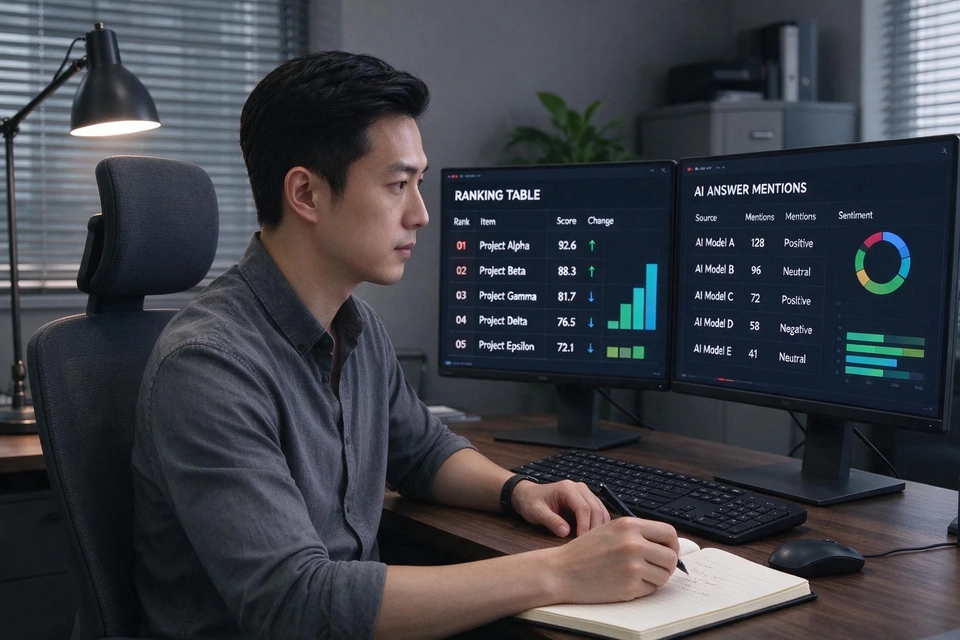
The shared commercial goal in both rows is valid queries. Ranking tables and question counts describe capacity, not results. A plan that promises a fixed number of tracked questions is promising monitoring volume; it is not promising that the same number of questions will convert. Any generative engine optimization singapore proposal framed around question counts deserves that reading.
The two numbers that get confused
AEO reporting uses a mention rate, and the definition carries more weight than the figure. Mention rate is the number of valid answers containing a brand mention divided by the number of valid answers gathered under identical conditions. Change the engine, the language, the region, the question wording or the sampling window and the denominator moves, so the rate moves while the brand does nothing differently.
Sampling adds a second layer. Engines are usually queried through an API, which is not identical to what a consumer sees on the site or in the app. Some adapters return no source or citation data at all; on that engine a source appearance rate cannot be computed and should not be recorded as a zero.
HubSpot's State of AEO in 2026 reports that 58% of marketers say their businesses are already optimising content for answer engines, and that 44% of marketers have made a business purchase based on brands they discovered through answer engines. The same report states a 433% brand citation improvement from its own doubling down on AEO. That last figure is one vendor's self-reported result with no published baseline period behind it, so it shows what one team observed; it is not a rate to plan against.
A worked split for one brand site
Take a professional services firm that already runs SEO against a fixed keyword list and wants to add AEO without paying twice for content. Four moves, in this order:
- Fix the question list before any baseline: which questions, which engine, which language, which region. Write the question wording down; an edited question is a new sample.
- Take the baseline first: mention rate, own-site source appearance rate, and a plain reading of how the engine describes the brand.
- Publish knowledge content that answers one buyer question per piece, with a direct answer, the context where it applies and the facts it rests on. Balance the piece count against the tracked-question count of the package, since each piece feeds one or two questions.
- Review citations and descriptions after the first month, then keep, cut or rewrite topics. Judge a piece by whether the engine now describes the brand accurately, not by whether it appeared at all.
On the SEO side the same firm keeps its keyword clusters and page work. When both services run together, the base creation of a shared piece of content is counted once, and extra page changes or technical work are listed separately. That is the line to defend in a budget meeting: shared content carries one author cost, and the two services are not two copies of the same invoice.
What a single dataset decides
Suppose the baseline shows a low own-site source appearance rate and a description problem on a few questions: the engine calls the firm a general consultancy when it only does compliance work for one sector. The next month of content should target those questions, not the ones already described correctly. That decision comes from the description check, which no ranking report produces.
On the SEO report for the same month a handful of keywords moved up, organic visits rose and bounce rate shifted. Neither report answers the other's question. Read as one scoreboard, they produce a compromise that hides which side is working.
What Topkee does with the two sides
Topkee does not sell an "AEO service" under that name. The brand-visibility problem behind generative engine optimization singapore demand is handled through its GEO service, which sits beside a traditional SEO service that targets top organic positions for commercial keywords. The two are sold as one joint plan, with brand data, topics and content assets shared.
The GEO side runs on tracked questions and knowledge content, priced by capacity per month in three tiers, with the number of simultaneously monitored questions set per tier rather than per monthly query run. The scope is fixed before quoting: one brand, one main website, one market, one content language. Content pieces are human-reviewed and counted on a delivery ledger, not by the software.
The SEO side is quoted by site foundation, keyword difficulty and scope, with no per-keyword price, because the same keyword costs different amounts on different sites. Say that plainly to a client comparing the two price lists: GEO is a standard subscription, SEO is an assessed project.
Measurement follows the same discipline. GEO reporting separates service delivery from search and AI visibility, then visits and engagement, then business results. The search-and-AI layer carries per-word rank, brand mention rate, own-site source appearance rate and description accuracy together. The limits sit in the same document: engines sampled by API are not identical to what each consumer sees, and a question where the brand was not mentioned is not evidence of a negative description.
What to do next
Before committing a line item, check how aeo surfaces describe your brand today and compare that with where you rank. [AEO vs. Search Rankings: AI Visibility Basics](https://www.topkee.com.sg/dynamic/ai-visibility-vs-search-rankings-is-your-agency-measuring) sets out the difference between the two reports, and AI-Powered Closed-Loop Marketing shows how the search and AI layers feed one review cycle. Then pick the side that needs next month's budget: if rankings are stable and descriptions are wrong, the GEO side is the gap; if descriptions hold and rankings do not, keep the SEO work going.
Running generative engine optimization singapore alongside SEO as one engagement also settles a reporting habit: each review looks at mention rate and ranking together, then answers the two questions separately. Teams that take the joint plan use aeo monitoring and the ranking report in the same monthly cycle, with one content calendar behind both.
FAQ
Does AEO replace SEO?
No. SEO targets a ranked position for a query; AEO targets a mention and an accurate description inside a generated answer. The same page can rank well and be described badly, or be described well without ranking for the head term. Most brands need both, sharing one content base.
How is AEO measured if clicks are falling?
By three figures taken together: mention rate (answers with a brand mention divided by valid answers), own-site source appearance rate, and a human check of description accuracy on a fixed question set. Clicks and organic sessions stay on the SEO report.
Can we run AEO work on the same content as SEO?
Yes, for the foundation. A well-structured page that answers a real question serves both. What changes is the output format: a direct answer, the context where it applies and verifiable facts in each piece, matched to a tracked question.
How long before an AEO programme shows a change?
Topkee's GEO packages run on a quarter-long implementation rhythm: goal, access, baseline and content plan come first, then the priority questions and first content, then theme improvements, then a review of next-stage investment. That is the delivery schedule; no ranking or citation deadline is attached to it.
Why does the price look so different from an SEO quote?
GEO is a fixed monthly subscription by capacity, which can be published in advance. SEO is quoted after a site review by difficulty, scope and workload, so there is no per-keyword price to publish. Comparing them row by row would compare a subscription with a project estimate.
Sources
- "Answer engine optimization vs. traditional SEO: What marketers need to know", HubSpot, 2026-11-11. https://blog.hubspot.com/marketing/aeo-vs-seo
- "Do people click on links in Google AI summaries?", Pew Research Center, 2025-07-22. https://www.pewresearch.org/short-reads/2025/07/22/google-users-are-less-likely-to-click-on-links-when-an-ai-summary-appears-in-the-results/
- "The State of AEO in 2026", HubSpot, 2026. https://offers.hubspot.com/state-of-aeo
- "AI Search Grader: Free One-Time AEO Brand Check, No Account Required", HubSpot, 2026. https://www.hubspot.com/ai-search-grader